History
In 1897, the first car ran on an Indian road. Through the 1930s, cars were imports only, and in small numbers.An embryonic automotive industry emerged in India in the 1940s. Hindustan Motors was launched in 1942, long-time competitor Premier in 1944, Mahindra & Mahindra was established by two brothers in 1945. in 1947, the Government of India and the private sector launched efforts to create an automotive-component manufacturing industry to supply to the automobile industry. In 1953, an import substitution programme was launched, and the import of fully built-up cars began to be restricted.
The 1952 Tariff Commission
In 1952, the government appointed the first Tariff Commission, one of whose purposes was to come out with a feasibility plan for the indigenization of the Indian automobile industry. In 1953, the commission submitted their report, which recommended categorizing existing Indian car companies according to their manufacturing infrastructure, with licensed capacity to manufacture a certain number of vehicles, with capacity increases allowable, as per demands, in the future. The Tariff Commission recommendations were implemented with new policies that would eventually exclude companies that only imported parts for assembly, as well as those with no Indian partner. In 1954, following the Tariff Commission implementation, General Motors, Ford, and Rootes Group, which had assembly-only plants in Mumbai, decided to move out of India
The Tariff commission policies, including similar restrictions that
applied to other industries, came to be known as the "license raj",
which proved to be the greatest undoing of the Indian automotive
industry, where bureaucratic red tape ended up causing demand to
outstrip supply, with month-long waiting periods for cars, scooters, and
motorcycles.
Passenger Cars
- Hindustan Motors, Calcutta – technical collaboration with Morris Motors to manufacture Morris Oxford models that would later become HM Ambassador.
- Addisons, Madras – An Amalgamations Group company, was the agent for Nuffield's Morris, Wolseley, and Riley cars, and Chrysler's Plymouth, Dodge, and De Soto cars and trucks. The first Morris Minor assembled in India and the first car assembled in Madras was driven out from Addison's twin-plants on Smith Road by Anantharamakrishnan on 15 November 1950.[5]
- Premier Automobiles, Bombay – technical collaboration with Chrysler to manufacture Dodge, Plymouth and Desoto models and with Fiat to manufacture the 1100D models which would later with Premier Padmini range.
- Standard Motor Products of India, Madras – technical collaboration from Standard-Triumph to manufacture Standard Vanguard, Standard 8, 10 and later Standard Herald.
Medium and Heavy Commercial Vehicles
 Matang truck manufactured by the Vehicle Factory Jabalpur of OFB
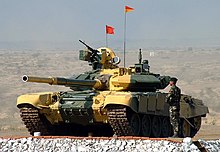 Bhishma Tank manufactured at the Heavy Vehicles Factory, Chennai of the OFB
 - Vehicle Factory Jabalpur – started manufacturing Shaktiman trucks with technical assistance from MAN SE of Germany. The trucks were the main logistics vehicle of the Indian Army with several specialist variants. VFJ still is the sole supplier of B vehicles to the Indian Armed Forces.
- Heavy Vehicles Factory – was established in 1965 in Avadi, Chennai to produce tanks in India. Since its inception, HVF has produced all the tanks of India, including Vijayanta, Arjun, Ajeya, Bhishma and their variants for the Indian Army. HVF is the only tank manufacturing facility of India.
- Tata Motors, Pune, then known as TELCO – technical collaboration with Mercedes Benz to manufacture medium to heavy commercial vehicles both Bus and Trucks.
- Ashok Motors, later Ashok Leyland, Madras – technical collaboration with Leyland Motors to manufacture medium to heavy commercial vehicles both Bus and Trucks. Ashok Motors also discontinued its Austin venture formed in 1948 to sell Austin A40 and retooled the factory to make trucks and buses.
- Hindustan Motors – technical collaboration with General Motors to manufacture the Bedford range of medium lorry and bus chassis.
- Premier Automobiles – technical collaboration with Chrysler to manufacture the Dodge, Fargo range of medium lorry, panel vans, mini-bus and bus chassis.
- Simpsons & Co, Madras – part of Amalgamations Group (TAFE Tractors) – technical collaboration with Ford to manufacture medium lorry and bus chassis, but did not utilise that option until the 1980s.
%27s_Matang_Truck_for_the_Indian_Army.jpg)


The Vespa 150 Sprint
- Many of the two-wheelers manufacturers were granted licenses in the early 1960s, well after the tariff commission was enabled.
- Royal Enfield (India), Madras – technical collaboration with Royal Enfield, UK to manufacture the Enfield Bullet range of motorcycles.
- Bajaj Auto, Poona – technical collaboration with Piaggio, Italy to manufacture their best selling Vespa range of scooters and three wheelers with commercial option as well.
- Automobile Products of India, Bombay (Better known for API Lambretta – technical collaboration with Innocenti of Milan, Italy to manufacture their Lambretta range of mopeds, scooters and three-wheelers. This company was actually the Rootes Group car plant that was bought over by M. A. Chidambaram family.
- Mopeds India Limited, Tirupathi – technical collaboration with Motobécane, France to manufacture their best selling Mobylette mopeds.
- Escorts Group, New Delhi – technical collaboration with CEKOP of Poland to manufacture the Rajdoot 175 motorcycle whose origin was DKW RT 125
- Ideal Jawa, Mysore – in technical collaboration with CZ - Jawa of Czechoslovakia for its Jawa and Yezdi range of motorcycles.
1970 to 1983
However, growth was relatively slow in the 1950s and 1960s, due to nationalisation and the license raj, which hampered the growth of the Indian private sector.The beginning of the 1970s saw some growth potential; and most of the collaboration license agreements came to an end, but with the option to continue manufacturing with renewed branding. Cars were still meant for the elite and Jeeps were largely used by government organizations and in some rural regions. By the end of the decade, some developments were made in commercial vehicle segments to facilitate the movement of goods. The two-wheeler segment remained unchanged except for to increased sales to the middle class in urban areas. There was emphasis on having more farm tractors, as India was embarking on a new Green Revolution; and Russian and eastern bloc imports were brought in to meet the demand.
But after 1970, with restrictions on the import of vehicles set, the automotive industry started to grow; but the growth was mainly driven by tractors, commercial vehicles and scooters. Cars still remained a major luxury item. In the 1970s, price controls were finally lifted, inserting a competitive element into the automobile market.[6] However, by the 1980s, the automobile market was still dominated by Hindustan and Premier, who sold superannuated products in fairly limited numbers.[7] During the eighties, a few competitors began to arrive on the scene.
The OPEC oil crisis saw increase need to installing or redesign some vehicle to fit diesel engines on medium commercial vehicle. Until the early 1970s Mahindra Jeeps were on Petrol and Premier commercial vehicles had Petrol model options. The Defence sector too had most trucks on Petrol engines.
1984 to 1992

First generation Maruti 800 launched in 1984

Chemical Biological Radiological and Nuclear Reconnaissance Vehicle (CBRN-RV) manufactured by the Ordnance Factory Medak of OFB
In 1984, the then Prime Minister of India, Indira Gandhi established the Ordnance Factory Medak, near Hyderabad. It started manufacturing Infantry Combat Vehicles christened as Sarath, the backbone of India's mechanised infantry. OFMK is still the only manufacturing facility of ICVs in India. To manufacture the high-power engines used in ICVs and main battle tanks, Engine Factory Avadi, near Chennai was set in 1987. In 1986, to promote the auto industry, the government established the Delhi Auto Expo. The 1986 Expo was a showcase for how the Indian automotive industry was absorbing new technologies, promoting indigenous research and development, and adapting these technologies for the rugged conditions of India. The nine-day show was attended by then Prime Minister Rajiv Gandhi.
Post-1992 liberalisation

Tata Indica, launched in 1998
.jpg)
Mahindra Scorpio was launched in 2002

The Maruti Suzuki Dzire and its hatchback version, the Suzuki Swift are the largest selling cars in recent years in India
Slow export growth
Exports were slow to grow. Sales of small numbers of vehicles to tertiary markets and neighbouring countries began early, and in 1987 Maruti Suzuki shipped 480 cars to Europe (Hungary). After some growth in the mid-nineties, exports once again began to drop as the outmoded platforms provided to Indian manufacturers by multinationals were not competitive.[9] This was not to last, and today India manufactures low-priced cars for markets across the globe. As of 18 March 2013, global brands such as Proton Holdings, PSA Group, Kia, Mazda, Chrysler, Dodge and Geely Holding Group were shelving plans for India due to the competitiveness of the market, as well as the global economic crisis.[10]Emission norms
In 2000, in line with international standards to reduce vehicular pollution, the central government unveiled standards titled "India 2000", with later, upgraded guidelines to be known as Bharat Stage emission standards. These standards are quite similar to the stringent European emission standards and have been implemented in a phased manner. Bharat Stage IV (BS-IV), the most stringent so far, was implemented first, in April 2010, in 13 cities—Delhi (NCR), Mumbai, Kolkata, Chennai, Bangalore, Hyderabad, Ahmedabad, Pune, Surat, Kanpur, Lucknow, Solapur, and Agra—and then, as of April 2017, the rest of the nation.Local manufacture encouraged
India levies an import tax of 125% on foreign imported cars, while the import tax on components such as gearboxes, airbags, drive axles, is 10%. Therefore, the taxes encourage cars to be assembled in India rather than be imported as completely built units.[11]Size
As of 2019, India is the 4th largest automobile market in the world, surpassing Germany in terms of sales.[12]Manufacturing facilities
The majority of India's car manufacturing industry is evenly divided into three "clusters". Around Chennai is the southernmost and largest, with a 35% revenue share, accounting for 60% of the country's automotive exports, and home of the operations of Heavy Vehicles Factory, Engine Factory Avadi, Ford, Hyundai, Renault, Mitsubishi, Nissan, BMW, Hindustan Motors, Daimler, Caparo, Mini, and Datsun.[13][14]Near Mumbai, Maharashtra, along the Chakan corridor near Pune, is the western cluster, with a 33% share of the market. Audi, Volkswagen, and Skoda are located in Aurangabad. Mahindra and Mahindra has an SUV and engine assembly plant at Nashik. General Motors, Tata Motors, Mercedes Benz, Land Rover, Jaguar, Fiat, and Force Motors have assembly plants in the area.[15][16]
The northern cluster is around the National Capital Region, and contributes 32%. Gurgaon and Manesar, in Haryana, are where the country's largest car manufacturer, Maruti Suzuki, is based.
An emerging cluster is the state of Gujarat, with a manufacturing facility of MG Motors, Atul Auto in Rajkot, Ford, Maruti Suzuki, and Peugeot-Citroen plants are also planned for Gujarat.[17]
Kolkata with Hindustan Motors (inactive), Noida with Honda, and Bengaluru with Toyota, Volvo and Scania and Andhra with Isuzu and Kia are other automotive manufacturing regions around the country.
Exports

Mahindra Scorpio in service with Italy's CNSAS.
According to The New York Times, India's strong engineering base and expertise in the manufacturing of low-cost, fuel-efficient cars has resulted in the expansion of manufacturing facilities of several automobile companies like Hyundai, Nissan, Toyota, Volkswagen, and Maruti Suzuki.[82]
In 2008, South Korean multinational Hyundai Motors alone exported 240,000 cars made in India. Nissan Motors plannned to export 250,000 vehicles manufactured in its India plant by 2011.[83] Similarly, US automobile company, General Motors had announced its plans to export about 50,000 cars manufactured in India by 2011.[84]
In September 2009, Ford Motors announced its plans to set up a plant in India with an annual capacity of 250,000 cars, for US$500 million. The cars were manufactured both for the Indian market and for export.[85] The company said that the plant was a part of its plan to make India the hub for its global production business.[86] Fiat Motors had announced that it would source more than US$1 billion worth auto components from India.[87]

In July 2010, The Economic Times reported that PSA Peugeot Citroën was planning to re-enter the Indian market and open a production plant in Andhra Pradesh that would have an annual capacity of 100,000 vehicles, investing € 700M in the operation.[89] PSA's intention to utilise this production facility for export purposes however remains unclear as of December 2010.

The Maruti Ertiga, a model exported by Maruti Suzuki, India.
Top 10 export destinations
India exported $14.5 billion worth of automobiles in 2014. The 10 countries below imported 47.8% of that total.[92]| Rank | Country | Value (US$) | Share |
|---|---|---|---|
| 1 | United States | 1.2 billion | 8.4% |
| 2 | Mexico | $1 billion | 6.9% |
| 3 | South Africa | $888.8 million | 6.1% |
| 4 | United Kingdom | $637.4 million | 4.4% |
| 5 | Sri Lanka | $596.9 million | 4.1% |
| 6 | Bangladesh | $592.1 million | 4.1% |
| 7 | Turkey | $580.4 million | 4% |
| 8 | Nigeria | $546.8 million | 3.8% |
| 9 | United Arab Emirates | $433.6 million | 3% |
| 10 | Colombia | $428.9 million | 3% |
Electric vehicle and Hybrid vehicle (xEV) industry
During April 2012, the Indian government planned to unveil the road map for the development of domestic electric and hybrid vehicles (xEV) in the country.[193] A discussion between the various stakeholders, including Government, industry, and academia, was expected to take place during 23–24 February.[193] The final contours of the policy would have been formed after this set of discussions. Ministries such as Petroleum, Finance, Road Transport, and Power are involved in developing a broad framework for the sector. Along with these ministries, auto industry executives, such as Anand Mahindra (Vice Chairman and Managing Director, Mahindra & Mahindra) and Vikram Kirloskar (Vice-Chairman, Toyota Kirloskar), were involved in this task.[193] The Government has also proposed to set up a Rs 740 crore research and development fund for the sector in the 12th five-year plan during 2012-17.[193] The idea is to reduce the high cost of key imported components such as the battery and electric motor, and to develop such capabilities locally. In the year 2017, An Amaravati, Andhra Pradesh based Electric Vehicles manufacturing company called AVERA[194] New & Renewable Energy started electric scooters manufacturing[195] and are ready to launch their two models of scooters by the end of December 2018.[196]Electric cars are seen as economical long-term investments, as one doesn't need to purchase gas, but needs only to recharge the battery, using renewable energy sources. According to the United States Department of Energy, electric cars produce half as much CO2 emissions as compared to a gas-powered car.[197] According to The Economic Times, 60% of Indian customers expect fuel prices to go up in the next 12 months and 58% expect to buy a new car in the same time frame. Most consumers are looking to buy a car which gives good mileage. According to the same source, 68% of Asian drivers expect higher mileage from their cars due to the higher fuel prices. This has encouraged 38% of Indian automobile consumers to switch to electric or hybrid cars.[198] Due to this change in the market, many companies, such as Toyota, have planned to introduce electric vehicles in India; and Suzuki has tested almost 50 electric prototypes in India already, according to Mashable.In 2019 Hyundai Launched India’s First Electric Car Kona Electric .
Automotive Research Association of India - Standards
The Government of India felt the need for a permanent agency to expedite the publication of standards and development of test facilities[214] in parallel with the work of the preparation of the standards - as the development of improved safety critical parts could be undertaken only after the publication of the standard and commissioning of test facilities. The Ministry of Surface Transport (MoST) constituted a permanent Automotive Industry Standards Committee (AISC) . The Standards prepared by AISC will be approved by the permanent CMVR Technical Standing Committee (CTSC). After approval, the Automotive Research Association of India (ARAI) [215] will publish this standard.Intelligent Transport Systems (ITS) are globally proven systems to optimize the utilization of existing transport infrastructure and improve transportation systems in terms of efficiency, quality, comfort and safety. Having realized the potential of ITS, Government bodies and other organizations in India are presently working towards implementing various components of ITS across the country.
The first step taken for creation and implementation of ITS was holding a National Workshop titled "User Requirements for Interactive ITS Architecture",[216] which was conducted as a collaboration between SIAM and ASRTU on 26 & 27 February 2015. This was primarily focused on ITS in Public Bus Transportation. Nonetheless, the workshop helped to create the outline for "National Intelligent Transport System Architecture and Policy for Public Transport (Bus)", which was submitted by ASRTU and SIAM to the government
In the 44th & 45th CMVR-TSC, Chairman had directed - standardization activities to be initiated on Intelligent Transportation Systems (ITS) - Vehicle Location Tracking, Camera Surveillance System and Emergency Request Button. The committee intended to extend the above user requirements to all public transportation namely –buses, taxis, etc. The current document covers the requirements for Vehicle Location Tracking and Emergency Button. The other ITS components like PIS, CCTV system, Fare collection etc. are deliberated and would be addressed in later phase and could be added as separate parts to the current document..
Based on these directions, the AISC Panel on ITS has prepared this AIS-140 titled,"Intelligent Transportation Systems (ITS) - Requirements for Public Transport Vehicle Operation". The panel also deliberated and identified the necessary elements for an effective implementation of vehicle level ITS system.
For AIS-140 Devices, in India, connectivity to report location, and Emergency Panic Button signal is though wireless cellular connectivity. There are device focused Cellular Connectivity Offerings like 'eSIM4Things[217]' available in India, which cater to connectivity requirements of AIS-140 devices.[218] eSIM4Things[217] is fully compatible with all AIS-140 devices and with a connectivity manager and a range of tariff plans


No comments:
Post a Comment